

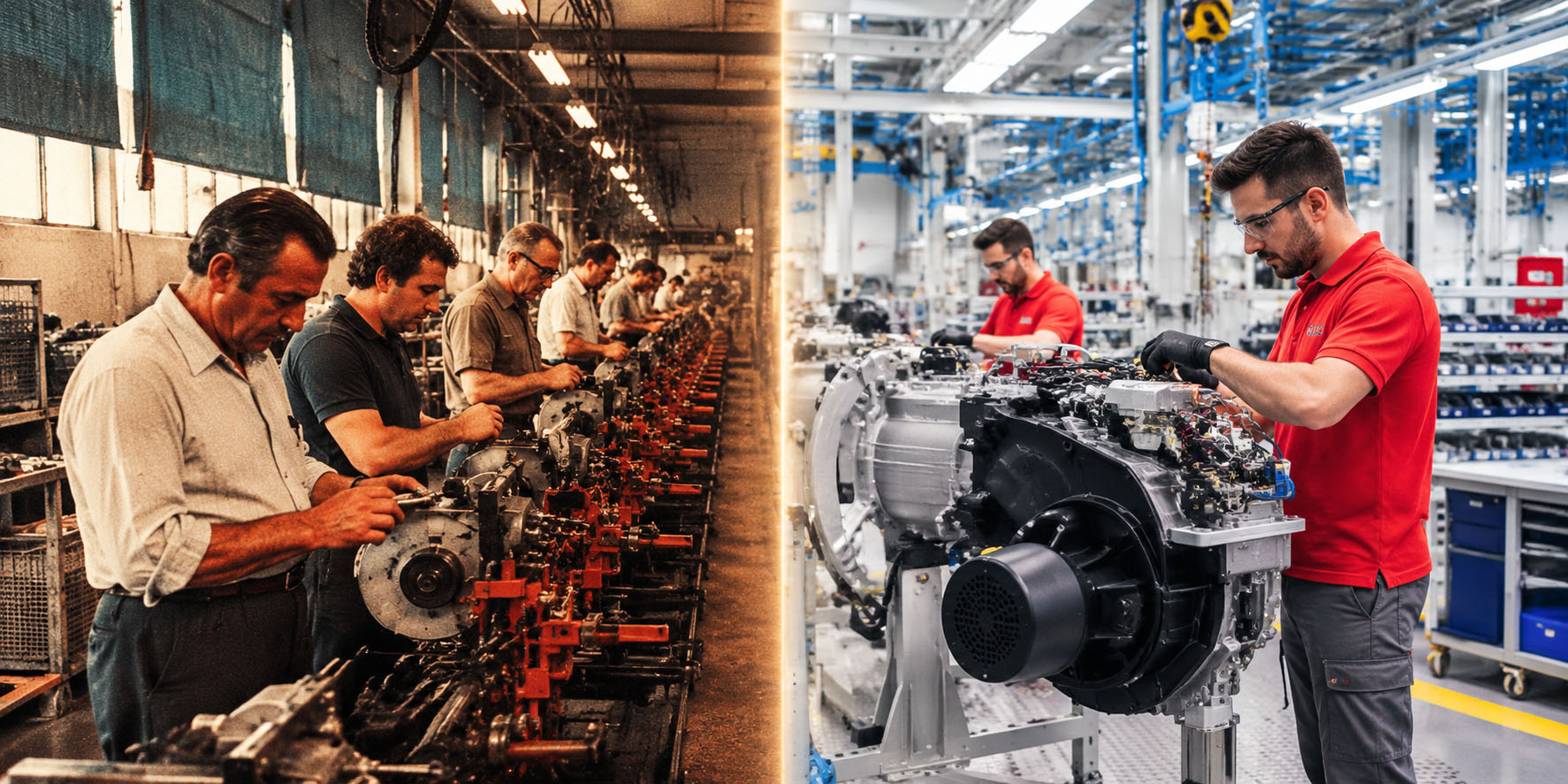
As Riello Burners, of Huntingdon, celebrates its 50th birthday, Key Accounts Director Graham Barker looks back at the history – and forward to the future – of the UK heating industry.
The spring of 1976 was a very different era for the UK heating sector.
System design was largely mechanical, efficiency was a secondary consideration to raw output, and standalone products dominated plant rooms across the country.
As the commercial landscape navigates the transition to lower-carbon technologies, our milestone offers a chance to reflect on how far the sector has progressed and where it is heading next.
Artisan roots
The Riello story began long before its UK arrival. The company has over 100 years of experience in the combustion sector since being founded by Pilade Riello in Legnago, Italy, in 1922, where his artisan workshop produced oil burners for bread-baking ovens.
He was considered one of Italy’s great entrepreneurs, with innovations that fundamentally changed how industries produce heat and hot water globally.
The company’s UK footprint began exactly 50 years ago. Riello burners were first sold into the British market in the spring of 1976 via a distributor agency based in Birmingham.
In 1992, it became an official Riello subsidiary, Riello Limited, and relocated to Huntingdon, Cambridgeshire. This coincided with the first waves of regulatory change in 1992, which would later reshape the commercial heating market.
This modernisation extended beyond the products to the way the business operated.
Reflecting on her time with Riello, Su Pearce, our Regional Sales Manager (South), explained: “Unlike the 1990s, when a customer could verbally request an order, all processes now require formal documentation. Today, all quotations need to be submitted in writing to enable them to be cross-referenced against a received purchase order, ensuring the corresponding invoice agrees with both.”
The race to cut emissions
The sheer scale of technological change is also something frequently discussed within the business.
Graham says: “Having started at Riello Ltd in 1994, I have witnessed significant transformation across the industry. Looking even further back to the burners of the late 1970s compared to today, the leap in technology is staggering.
“Back then, engineering was purely mechanical. Today, the focus is on digital controls, micro-tolerances and emissions reductions that would have been unthinkable 50 years ago.
“In the early days, regulations such as the Building Regulations 1965 (updated in 1984) and the Clean Air Act 1956 were in force, neither of which placed great emphasis on the products of combustion.
“With the introduction of European regulations in the late 1990’s, more stringent maximum levels were imposed to better control and limit harmful emissions released into the atmosphere, with a focus being Nitric Oxide (NOx) emissions.
“Riello prides itself on providing engineer-friendly burners, and it was these types of products that helped build the large market share the company continues to experience today”.
However, the sector now faces challenging regulations, and the ongoing drive to reduce NOx has been a major catalyst for new technology.
Nathan Chance, National Commercial & Industrial Technical and Sales Manager, says: “Typically, burners were built around reliability using conventional fossil fuels with limited environmental constraints.
“We now live in a world where those environmental constraints are the absolute focal point for commercial and industrial heating systems.”
The Energy Related Product (ErP) regulations introduced in 2018 brought far more stringent requirements (though specific limits and compliance requirements can vary depending on product type, capacity and installation context).
Nathan adds: “Regulations such as ErP and MCPD place strict limits on NOx emissions, requiring us to adopt improved burner technology. The challenge is improving efficiency and reducing operating costs while still maintaining that core burner reliability.”
This regulatory shift required a massive acceleration in research and development and resulted in a much more complex combustion head design that incorporates internal flame recirculation and exceptionally tight tolerances.
To meet the rising global demand for complex engineering solutions, the Riello Combustion Research Centre in Angiari, Italy, tripled in capacity in 2001. The company continues to utilise these world-renowned facilities to provide market-leading products with the lowest emissions available.
As the burner range has increased in complexity over the years, Su points out: “Technical knowledge of the products is most definitely an advantage and actively assists with sales offerings.
“I know that seems obvious now, but it’s easy to take for granted the sheer technical revolution that’s occurred in the last half-decade. Detailed technical information – and ready expertise of our sales teams – must be available to support quotes and on-the-spot enquiries.”
Ecosystem era
Alongside this technical evolution, Su observes: “There’s also an increased expectation for responsiveness around day-to-day enquiries, burner matching advice and spare parts. You really need to provide answers immediately or within the same day for these requests, while endeavouring to turn around even the most complex enquiries as quickly as possible.”
This agility is crucial as the industry shifts away from isolated equipment towards integrated energy ecosystems. High-efficiency burners are no longer standalone workhorses; they must operate alongside advanced controls, variable fuel sources and building management systems. Installers and specifiers are increasingly working within systems that require compatibility between diverse technologies rather than reliance on a single solution.
The hybrid future and alternative fuels
This brings the industry into the future. Rather than signalling the end of combustion technology, the current push towards net zero is redefining its role within a broader, more integrated energy system.
Nathan explains the operational advantages: “The adoption of alternative fuels is a challenging aspect for burner technology and combustion systems. HVO is widely considered a low-carbon replacement for diesel, and while it is frequently discussed for residential use, it is equally important for commercial and industrial projects.
“HVO is a major step forward for the industry, offering potential carbon savings of up to approximately 88%, based on published UK government data comparing HVO with conventional fossil fuel oils such as kerosene.
“Crucially, it can often be introduced into existing systems with limited modifications, allowing the end user to switch fuels without significant maintenance or appliance downtime.”
Furthermore, manufacturers like Riello are not just reacting to change but actively testing the infrastructure of tomorrow. This is evidenced by the development and supply of 100% hydrogen-ready systems designed to support UK government research programmes, such as the Hy4Heat trials.
“Hydrogen presents even greater challenges due to its high flame speed and wider flammability range,” says Nathan. “While research and development pose a challenge, Riello is at the forefront with specific burner ranges ready for a 20% hydrogen blend.
“Although we have had great success in tests firing 100% under controlled conditions on hydrogen on multiple burner ranges, including the UK Hy4Heat projects, it’s all subject to the development of a formal regulatory framework before any commercial deployment into the global market.”
The next 50 years
The UK market operating today is vastly different to the one Riello entered in 1976. While the need for reliable, efficient and well-supported heating solutions hasn’t changed, how those solutions interact with wider system technologies and future energy demands certainly has.
The UK heating sector will continue to diversify rather than converge on a single solution. Electrification will grow, but so too will the need to optimise existing infrastructure and integrate multiple technologies in a coherent, efficient way.