


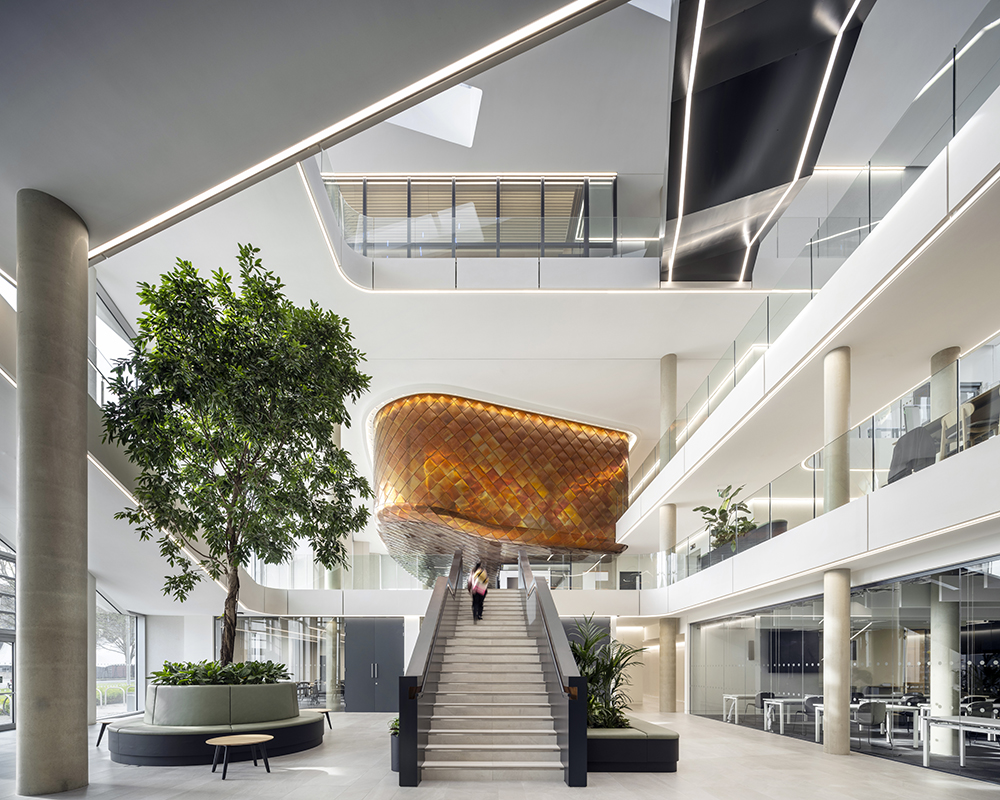
Businesses can now book conferences, meetings and events at state-of-the-art Ray Dolby Centre through Meet Cambridge.
The Centre, the new home of the University of Cambridge’s world-renowned Cavendish Laboratory, officially opened last May, carrying the legacy of some of history’s most transformative discoveries, including the electron, the neutron, and the double helix structure of DNA.
Located in the Cambridge West Innovation District and purpose-built as a collaborative research hub, it combines cutting-edge labs with lecture theatres and adaptable event spaces, all crowned by a stunning restaurant with panoramic views.
A spokesman said: “The Ray Dolby Centre is a symbol of what Cambridge represents – a place where the brightest minds come together to solve the world’s greatest challenges.
“This is exactly why Cambridge remains a globally recognised destination and why we are thrilled to offer this incredible venue exclusively as part of our free venue-finding offering.”
Recently named Europe’s most intensive science and technology cluster and ranked second globally (Global Innovation Index 2025), Cambridge stands shoulder to shoulder with San Francisco, Boston, and Shanghai as one of the world’s foremost hubs of discovery.
Eve Stupart, Conference Manager at the Ray Dolby Centre, said: “We’re delighted to join forces with Meet Cambridge. The Centre was built to encourage collaboration and fresh thinking, making it an ideal setting for conferences and meetings that aim to spark new ideas and connections.”
The Ray Dolby Centre represents the next chapter in Cavendish Laboratory’s 150-year legacy of pioneering physics. As a major new asset for both the University and the city, it is set to revolutionise research and education in physics at Cambridge.
Named Ray Dolby after the former Cambridge student who invented surround sound, the centre has been tailored to support a diverse array of physics research, including 173 laboratories, lecture halls, learning and collaborative spaces, workshops, cleanrooms and offices.